2026 Concept
Project Title: Fragmento I
Artist: Teresa Royo
Discipline: Contemporary Dance / Dance-Theatre / Choreographic Research
Country: Spain / The Netherlands
PROJECT STATEMENT
Fragmento I is a choreographic research project that expands the universe of the work TOTHOM and its first chapter, Fragmento I. This residency seeks to deepen an ongoing line of investigation in which the body becomes an emotional archive, a storyteller, and a space for memory. During this residency, I aim to explore how physicality can reveal what remains unspoken: how a body remembers, transforms, breaks, and rebuilds itself. The project emerges from a personal and artistic intuition: my body speaks before I do. In this territory of intuition, breath, and impulse, the research takes shape. My approach is strongly influenced by Pina Bausch, Bobbi Jene Smith, and Alan Lucien Øyen, whose practices merge dance and theatre with profound emotional integrity. Their work opens a guiding possibility for this project: an art form in which emotion moves, trembles, and breathes. Through this residency, I seek to develop a choreographic language that is poetic and physical; intimate yet expansive; fragmented yet coherent; an emotional continuation of TOTHOM; and a new ritual for the body, memory, and gaze.
CONCEPT & RESEARCH FRAME
This project proposes a sensorial and emotional journey rooted in the previous exploration of TOTHOM, where the body functioned as both archive and witness. In this new phase, the body becomes the engine of narrative and meaning, shaping its own internal landscapes. The research is guided by the following questions: How does the body store memory? How can movement reveal emotional states that language cannot express? What rituals appear when the body is placed in a state of honesty, vulnerability, or rupture? How do everyday gestures acquire poetic weight through attention and repetition? How does space participate in or alter memory? The project investigates non-linear dramaturgies, where meaning arises through sensation, rhythm, and imagery rather than conventional narrative structures.
THEMATIC AXES
The body as emotional territory; physical memory and somatic storytelling; fragility and human vulnerability; the beauty of everyday gestures; identity in motion—an identity that shifts, changes, and breathes. These themes guide the movement material, improvisation tasks, visual research, and dramaturgical decisions throughout the residency.
ARTISTIC APPROACH
The project sits at the intersection of dance-theatre, somatic research, and poetic imagery. Movement is approached as an emotional consequence, emerging from memories, emotional states, and physical impulses rather than fixed choreography. The dramaturgy is fragmented, unfolding in units like breaths or memories, where discontinuity generates coherence. The body is explored as a landscape with texture, temperature, density, fragility, and resistance. Everyday gestures are studied through repetition, expansion, and distortion, becoming tools to reveal internal processes. Embodied listening—attention to breath, weight, timing, and space—shapes the internal dramaturgy of the movement.
VISUAL & ATMOSPHERIC PHILOSOPHY
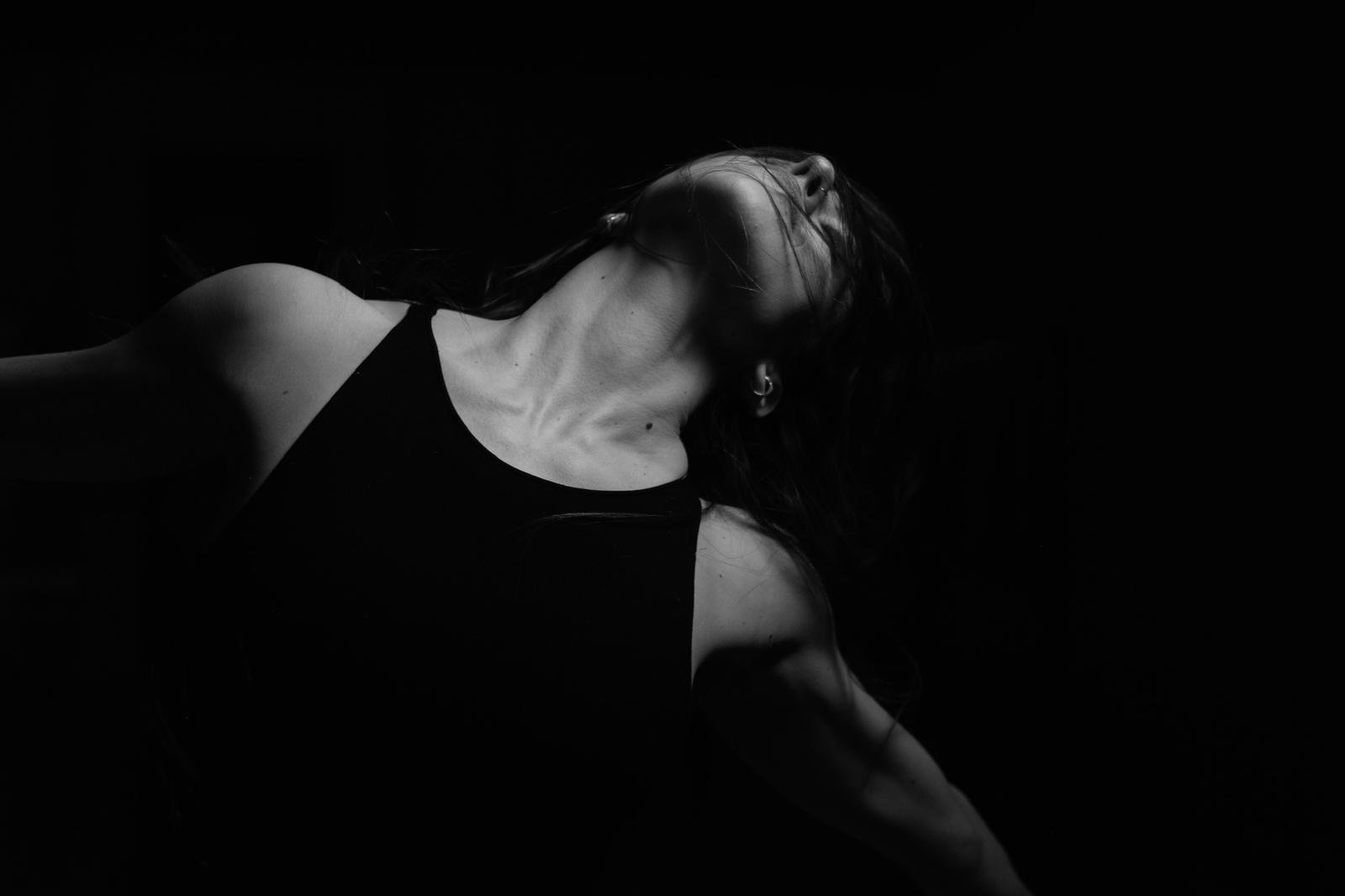
Although Fragmento I is primarily a choreographic project, the visual dimension plays a crucial role. The aesthetic draws inspiration from analog photography: warm, burned tones; visible grain and imperfect textures; delicate shadows; intimate framing; and tactile, emotional atmospheres. The project treats the everyday as something sacred and the body as a living landscape. Visual references include Pina Bausch, Bobbi Jene Smith, and Alan Lucien Øyen.
STRUCTURE OF THE PROJECT (Three Fragments)
Fragment I — The Body in Relation: Search, encounter, rupture (“Estoy bien”). This fragment explores expansion, conflict, and the emotional tension between the self and the Other.
Fragment II — The Body as Memory: The origin—minimal gestures, physical recollection, somatic awakening; a landscape where emotion begins to surface.
Fragment III — The Body that Recognizes Itself: Integration and return. Gestures reappear transformed; the body finds honesty, clarity, and quietness. A poetic farewell. Each fragment functions as a chapter of emotional transformation, allowing the residency to unfold through experimentation and reflection.
RESIDENCY GOALS
During the residency, I intend to develop a solid movement vocabulary rooted in memory and emotional truth; build a dramaturgical map of the three fragments; research somatic improvisation tools that support emotional embodiment; explore relationships between gesture, breath, and spatial composition; create visual and choreographic material for future staging or film adaptation; and establish a reflective practice (journaling, video documentation, photography) to accompany the research process.
EXPECTED OUTCOMES
The residency will produce a movement archive (improvisation tasks, physical scores, emotional maps); a preliminary dramaturgical structure in three fragments; visual sketches (photography and video excerpts); a research logbook documenting discoveries, failures, and open questions; and material that will serve as the foundation for a future stage work or dance-film. Presentation format can adapt to the residency context (open studio, sharing, or talk).